
Files Allege Jeffrey Epstein Spent Time Living with Pope John Paul II in Vatican
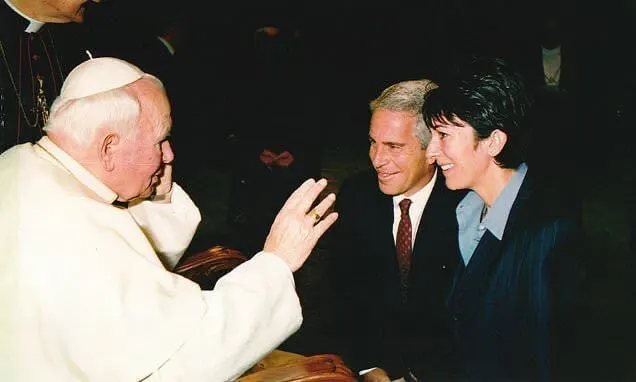
It’s not surprising that the Vatican shows up in the Epstein files since Epstein kept tabs on every powerful entity on the planet. But one email claims Epstein actually lived in the Vatican with Pope John Paul II at some point.
An email from Brandon Thompson, who appeared to be a contractor working on refinishing and lime-washing columns in one of Epstein’s homes, outlined the intricacies of the project to Richard Kahn at HBRK Associates, Epstein’s accountant.
“He wants me to finish each column different, as when he was living with Pope John Paul the Second in Vatican, he looked at variety of different columns captured in wars,” wrote Thompson. “He told me that every Pope demanded to have a column from every concurred [SIC] country, so there is a collection of different columns in Vatican.”
Of course there is no proof that Epstein lived with the Pope, although he and Ghislaine Maxwell visited with him in 2003 during a public audience. Just how intimate Epstein was with the Vatican is unknown, but in 2011 he claimed to have nearly possessed the Codex Vaticanus, one of the oldest and most important Church relics containing a majority of the Greek Old Testament and the majority of the New Testament. The Codex was famously seized by Napoleon in 1799 as a war trophy but was returned to the Vatican Library in 1815.
In an email to Boris Nikolic, who was a science advisor to the Bill Gates Foundation at the time and a close Epstein confidante, Epstein wrote, “I forgot to mention to Bill, that one of the first almost interactions with him was when I was the underbidder for the codex…The auctioneers told me that i shold drop out because if i owned them, no one would ever see them and they really should be in semi public hands.. I later had to settle for a present from the vatican of a special edition.”
One of the most revealing emails about Epstein’s alleged ties to the Vatican is a 2013 correspondence with Larry Summers, former U.S. Treasury Secretary under President Bill Clinton, former Harvard President and former chief economist at the World Bank. Epstein writes, “The most important change in the Vatican may not be Pope Benedict XVI sudden retirement but the change in leadership at ‘the Institute for Works of Religion,’ the Vatican’s bank. Because of the Vatican’s status as a sovereign country, it is exempt from transparency rules of not only Italy— but of the European Union. This status allows its elite clients to evade any scrutiny in their money transfers.”
“Last May,” continued Epstein. “Vatican Bank President Ettore Gotti Tedeschi was fired after Italian authorities opened an investigation into a far flung bribery scheme in which he was allegedly involved. Then 47 dossiers, including compromising about “internal enemies” of his in the Vatican were found in a search of his home. They had instructions how they were used in case something happened to him. Tcdeschi’s intercepted calls futhcr revealed that his concern was that he would be assassinated because he knoew the Vatican’s secrets. By late 2012, he was cooperating with the ongoing Italian investigation, It was at this point that the all-powerful College of Cardinals, in one of the last acts in the Benedict papacy, appointed German lawyer Ernst von Freyberg as President of the bank. The came the extraordinary resignation of Pope Benedict.”
Freyberg had a short tenure as Vatican Bank president. He was named in June 2012 as an interim leader, then appointed president in February of 2013. Von Freyberg quickly began to open up the bank and adopted a zero-tolerance approach to suspicious activities, advocating transparency. He was dismissed in July along with the Vatican Bank’s entire senior management team as part of extensive reforms to the Catholic Church’s central government.
Jean-Baptiste Douville de Franssu has been chairman of Vatican Bank’s advisory board since July of 2014.